Village Zero
Data and reproducibility
Research materials
Download the observations behind the figures, follow individual calls to their receipts, and inspect the registered implementation references.
Public evidence
Data behind the results
Each extract preserves its unit of observation and identifies its original study records. The manifest defines the fields, records provenance and supplies SHA-256 digests for all 15 extracts.
Study designs and observations
- Historical study profilesResident counts, models, seeds, starting states, observation windows and units for all five study designs.
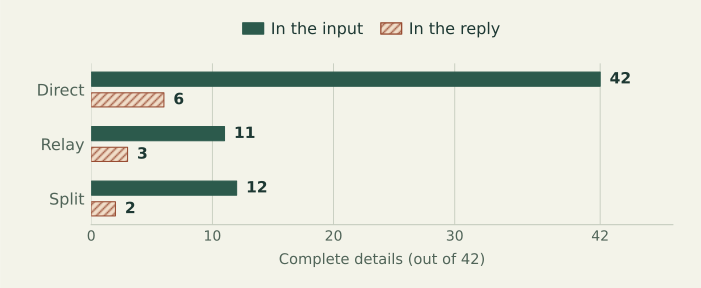
JSON · 13,898 bytes - Parcel transmission18 endpoint rows. Seven incoming and spoken detail codes for each combination of route and seed.
CSV · 2,380 bytes - Tavern evening stages16 original worlds. Preparation, collection and service receipts, plus the pickup location and deadline in absolute game days.
CSV · 1,815 bytes - Long-Life paired historiesOne row for each of the 16 post-fork branches, including branches with zero displayed opportunities. Compare A and B within each history.
CSV · 1,571 bytes - Turns that offered joint restAll 112 post-fork turns whose menu contained a join action. Repeated presentations are separate rows. Completions point to a world event.
CSV · 9,721 bytes - Turns that exposed a purchase52 prompts containing an immediately executable purchase. Settlements include their transaction event IDs.
CSV · 2,544 bytes - Same-offer continuationsSix live replays. Buyer slot, legal exposure, decision category, receipt and outcome by expiry and at a five-call budget.
CSV · 1,436 bytes - Priority after inspecting an offerExperiment 73. Four selected states, two seeds per state and three policies. Each row gives the outcome, call budget and change to the order of turns.
CSV · 5,259 bytes
Evidence from individual worlds
- Four places and five positionsThe route graph and tick-48 resident positions from the R06 checkpoint, with the identifying digest.
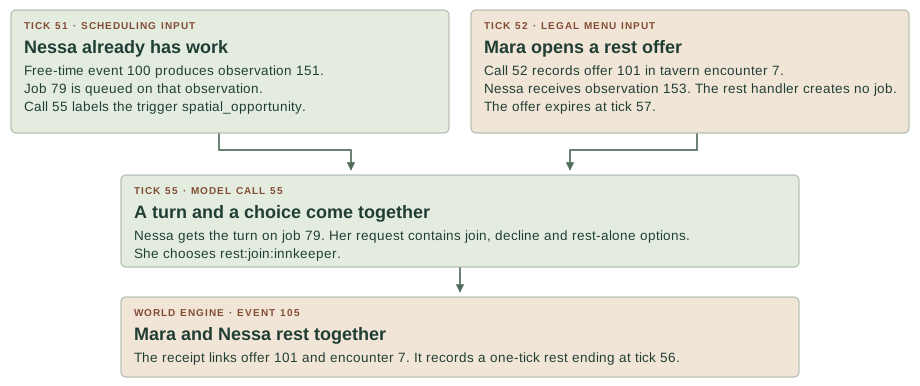
JSON · 1,907 bytes - The tavern invitationR06/A job 79 from event 100 and memory 151, the separate invitation 101, Nessa’s shown actions at call 55 and receipt 105.
JSON · 3,250 bytes - What fit in Toren’s packetR07/B call 294. Available, included, omitted and cited memory record IDs, measured prompt size, selected action and sale receipt.
JSON · 3,270 bytes - Market, memory and quiet intervalsSelected public utterances, displayed record identifiers, actions and receipts for R01/B, R06, R07 and R08/B.
JSON · 18,047 bytes
Engineering records
- Long-Life compute ledgerDecision calls, input and output tokens, model seconds and request seconds, by phase and for the full run.
CSV · 281 bytes - Measured runtime profileRecorded hardware, quantization, packet and runner limits, timer definitions and measurement boundaries.
JSON · 5,395 bytes - Registered implementation referenceRevision, source filenames, symbols, line ranges and digests for the mechanisms described on the architecture page.
JSON · 8,269 bytes
Reading a record
Start with the world and branch
Event and decision identifiers are local to a named world. A physical call record has its own identifier. Follow the named branch, tick and local call ID before joining an event to a model decision.
R01/B · Sale
Words, then a transfer
Ilan’s inherited call 36 mentions a crate and two coins. Mara responds in branch call 51. The settled transaction appears later, in branch call 55, event 112. It records two crates for four coins. The projected before-and-after balances allow the transfer to be checked.
Sources · Selected journal cases
R07/A · Memory
Retrieved, shown, cited
Call 133 requests a search. Records 94, 185 and 146 appear in the merchant’s later packet and are cited when he offers stock to the smith at call 138. This is evidence of exposure and citation. Testing whether those records changed the choice requires a controlled intervention.
Sources · Selected journal cases
Working with the data
Reproduce a claim from public rows
The numerical figures and their underlying data are included in this publication. Counts from the public tables can be checked with a spreadsheet or any CSV reader.
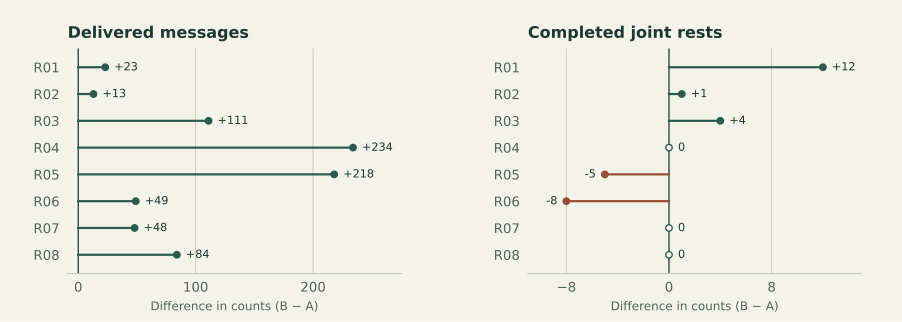
- Recreate a pairGroup the Long-Life table by
history. For each metric and each of R01–R08, subtract the A count from the B count. Those are the points in the paired figure. - Check a denominatorFilter the joint-rest opportunity table by schedule. Count the rows with a completion receipt, then count all displayed turns. A gives 32/38 and B gives 36/74. The paired-history table includes branches where the option never appeared.
- Verify an extractCalculate SHA-256 on the downloaded bytes and compare it to the file’s manifest entry. The optional verifier checks the hashes and recomputes the main comparisons.
With Python 3, run python verify.py from this resources folder, or supply the directory containing the manifest as the first argument. The site itself needs only a browser.
Technical reference
What the release can verify
Public tables reproduce the reported counts. The architecture reference locates the implemented mechanisms at a pinned revision. The complete SQLite databases, full communication logs and private resident notebooks are retained in the research archive.
Long-Life registration
Study long-life-20261118-r01-r08
Revision 4f5a2bf3e2331bde4b88f4d69917c6e1409e2a19
Original archive SHA-256ffecd50531eca3c1ec2442fe6ade54b02d62d87a1493ade202ea106c0f3b0eb1
These identifiers support comparison with an authorized archive copy. They are archival references.
Read the mechanisms
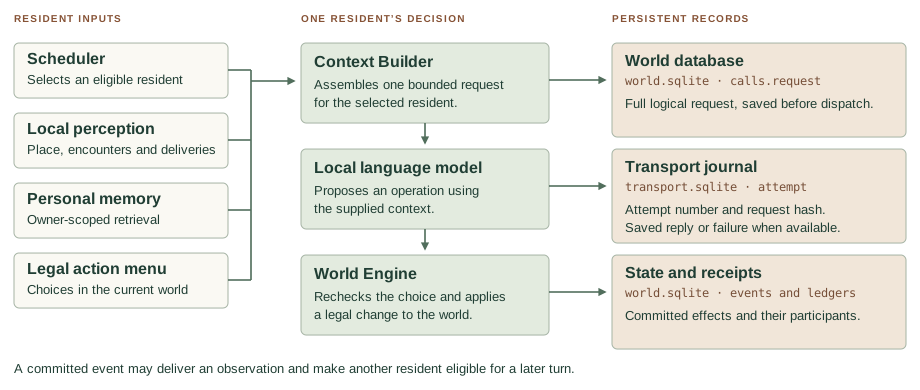
Examine how local perception feeds a decision packet, where engine authority begins, and how the runtime distinguishes saved-reply recovery from fresh inference.